
Air Duster vs. Car Vacuum for Vents and Crevices: Which Works Best?
Should you use an air duster or a portable car vacuum for AC vents and tight crevices? Using an air duster alone dislodges trapped louver dust but scatters fine particles across clean cabin seats and upholstery. A standalone car vacuum captures loose grit but fails to reach deep inside micro-crevices. The ultimate solution is using a dual-action tool that dislodges hidden debris with high-velocity air and immediately extracts it with 19,000Pa suction power.
Air Duster vs. Vacuum: Vent & Crevice Performance Matrix
| Cleaning Scenario / Interior Zone | Air Duster (Blower Mode) | Standard Car Vacuum (Suction Only) | 2-in-1 Dual Action Tool (Push & Capture) |
| --- | --- | --- | --- |
| Deep AC Vent Louvers (Trapped Fine Dust) | Dislodges deep louver dust effectively but scatters particles into cabin air. | Captures surface dust at vent openings; misses dust behind inner slats. | Blows dust out of inner channels and extracts particles before re-settlement. |
| Piano Black Console Trim (Scratch-Prone Plastic) | Safely levitates abrasive grit without physical surface contact. | Hard plastic nozzles risk swirl marks if dragged across glossy trim. | Soft brush blower dislodges grit, followed by floating brush suction extraction. |
| Tight Center Console Seams (Food Crumbs & Sand) | Pushes crumbs deeper into dashboard seams and lower climate controls. | Struggles if seam opening is narrower than standard 10mm crevice tool. | Micro-nozzle jet blasts crumbs out of seam directly into 19,000Pa suction path. |
| Speaker Mesh Grilles (Embedded Lint & Dust) | Forces dust particles through mesh perforations onto speaker cone membrane. | Lacks sufficient static lift to draw embedded lint out of small mesh holes. | Reverse airflow dislodges trapped lint from mesh while high vacuum extracts it. |
| Under-Seat Tracks & Rail Seams (Gravel & Pet Hair) | Creates massive dust clouds and blows heavy debris under carpet mats. | High suction lifts heavy gravel and pet hair tangled in rail grease. | High-power 19,000Pa suction mode extracts heavy debris without airborne drift. |
To choose the right cleaning method, you must evaluate how air dusters and portable vacuums perform across specific interior vehicle zones and common detailing failure modes.
Pros and Cons: Evaluating Core Trade-Offs & Failure Modes

Photo by Tima Miroshnichenko on Pexels
Pros
- Air Dusters penetrate deep, sub-millimeter louver channels without touching fragile vent blades.
- Air Dusters remove abrasive sand from piano black trim without risking swirl micro-scratches.
- Portable Vacuums remove dust down to 0.3 microns using HEPA filtration rather than re-circulating it.
- 2-in-1 Tools combine 50,000 RPM blowing velocity with 19,000Pa suction to dislodge and capture debris simultaneously.
- Standalone Air Dusters scatter dislodged particles across fresh leather seats, carpet, and clothing.
- Blowing air directly into dashboard vents while HVAC fans are running forces dust into duct bends.
- Rigid plastic vacuum crevice tools can gouge soft dashboard vinyl or scratch touchscreens.
- Low-power handheld vacuums lack the negative pressure needed to draw debris out of deep console seams.
Expert Detailing Tip: The Push-and-Capture Method
Professional automotive detailers never use an air duster in isolation inside an enclosed vehicle cabin. To clean vents without creating secondary cleaning work, use the Push-and-Capture Method:
This technique levitates stubborn static dust out of dark vent recesses and immediately pulls it into a sealed HEPA dirt bin, keeping your freshly detailed seats pristine.
Recommended Solution: Belibuy 6-in-1 Cordless Vacuum & Air Duster
Why choose between blowing and vacuuming when you can do both with a single ultra-lightweight device? The Belibuy Handheld Cordless Vacuum Cleaner is engineered specifically to eliminate the trade-offs of vent and crevice detailing.
- Dual-Action Cleaning Power: Features a high-speed 50,000 RPM motor delivering 19,000Pa suction power alongside a concentrated air duster exhaust port.
- Ultra-Lightweight Comfort: Weighs just 0.81 lbs, allowing precise one-handed maneuvering around delicate infotainment bezels and tight steering column gaps.
- Advanced HEPA Filtration: Washable HEPA filter traps 99.97% of fine particles down to 0.3 microns, preventing vent dust from re-entering your cabin.
- Smart LED Charge Display: Visual green-light indicator ensures you never run out of power mid-detail.
- 6-in-1 Versatility: Includes specialized crevice tools, micro-duster nozzles, and soft bristle brushes for scratch-free detailing on piano black trim and keyboards.
Key Takeaways: Air Duster vs. Vacuum Summary
- Blowing alone creates secondary mess: Air dusters are unmatched for dislodging static dust inside vent louvers, but they scatter debris onto seats and carpets if not paired with suction.
- Vacuuming alone misses deep crevices: Standard vacuum nozzles cannot enter sub-5mm gaps behind AC louver blades without risking mechanical damage to the vent tilt mechanism.
- Watch out for piano black trim: Never drag hard plastic vacuum nozzles across glossy interior trim; use air duster levitation or soft brush vacuum attachments to prevent swirl scratches.
- 2-in-1 tools offer complete control: Devices combining a 50,000 RPM blower and 19,000Pa vacuum suction allow you to push debris out of tight spots and extract it in a single pass.
- Filter maintenance is essential: Capturing microscopic vent dust requires a clean, washable HEPA filter to maintain maximum suction pressure.
Decision Guide: Selecting the Right Airflow Tool
Choose an air duster mode to dislodge caked dust trapped deep inside vent ductwork and speaker grilles. Choose high-Pa vacuum suction to extract loose crumbs, sand, and pet hair without airborne drift. For absolute cabin efficiency, rely on a dual-function 2-in-1 tool.
Best choice for
- Air Duster Mode (Concentrated Air Jet) — Airflow reaches deep internal channels where rigid vacuum nozzles physically cannot fit.
- 19,000Pa Vacuum Suction Mode — Negative pressure traps heavy debris directly into a sealed bin, eliminating cabin dust clouds.
- Belibuy 6-in-1 Cordless Vacuum (Dual Mode) — Allows instant switching between blowing debris out of micro-crevices and capturing it with HEPA filtration.
- Avoid using a standalone air duster inside a closed vehicle with allergic passengers present.
- Avoid using hard plastic vacuum crevice tools directly on glossy piano black trim or capacitive touchscreens.
- Microfiber detailing swabs with mild interior cleaner — Effective for sticky liquid spills inside vents, though slow for routine dry dust removal.
Featured Detailing Tool
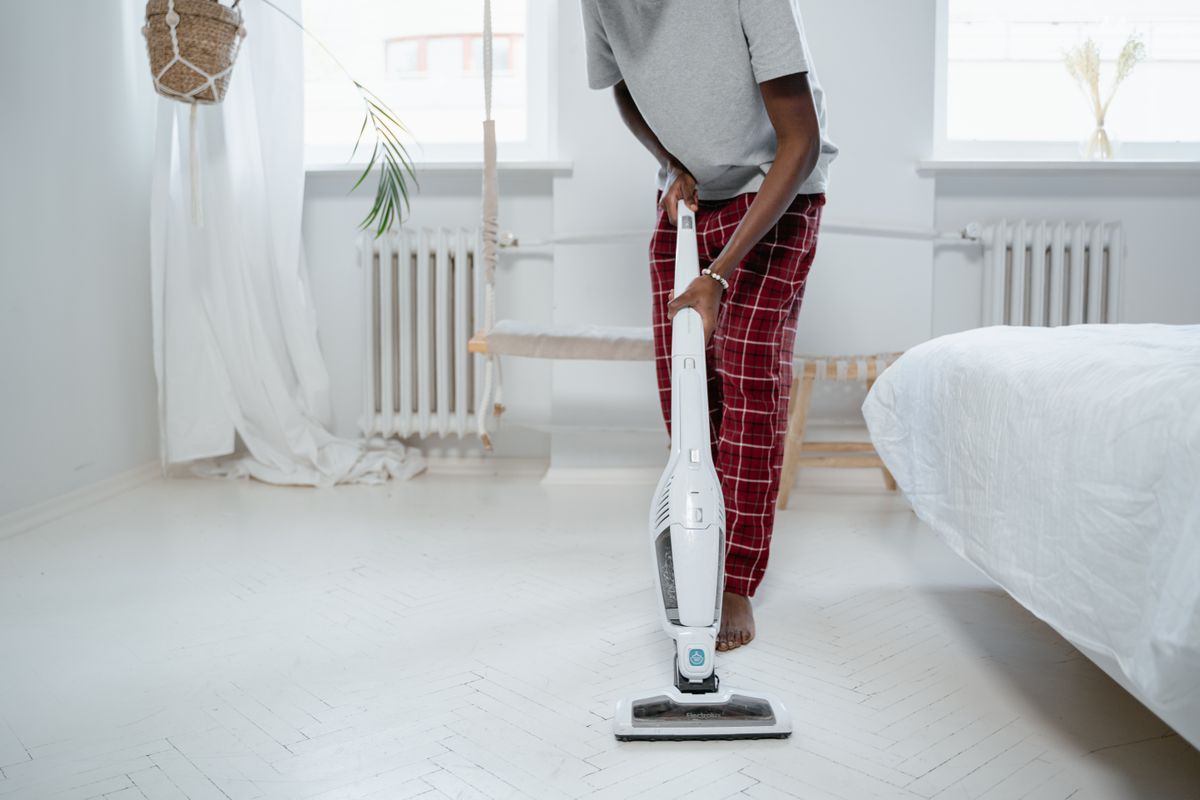
Photo by MART PRODUCTION on Pexels
The single most effective tool for resolving the duster vs. vacuum debate is a high-speed, dual-mode portable cleaner designed for tight automotive spaces.
Real-World Detailing Scenarios: Matching Tool to Task
Scenario A: Dry, caked dust on AC vent slats after winter storage — Use Air Duster mode with a narrow cone nozzle to dislodge dry dust from behind vent louvers, while holding the vacuum inlet with a soft brush attachment directly in front of the vent to catch escaping airborne particles.
Scenario B: Dried soda syrup or sticky coffee residue inside vent channels — Neither air dusters nor vacuums remove dried liquids alone. Lightly mist a foam detailing swab with interior cleaner, wipe the louver slat clean, then blow dry with Air Duster mode before vacuuming surrounding dust.
Scenario C: Dust buildup around delicate steering wheel buttons and infotainment screens — Attach the soft bristle brush nozzle to the vacuum. Use low-pressure duster bursts to float dust out of button seams while lightly gliding the brush attachment over glass bezels to extract debris without scratching.
Scenario D: Food crumbs wedged between center console seams and leather seat bolsters — Fit the narrow crevice attachment and activate maximum 19,000Pa suction mode. Draw the nozzle slowly along the seat track seam to pull wedged organic matter into the transparent dirt container.
Different interior automotive challenges require distinct airflow dynamics and nozzle selections.
To achieve professional-grade results when detailing a vehicle interior, you must understand how microscopic dust particles behave inside high-velocity HVAC ducts and narrow plastic crevices.
Static Charge and Particulate Drift
Automotive interior plastics—particularly ABS vent louvers and glossy acrylic console trim—develop static electricity through regular air friction. As dry air moves through your car's climate control system, fine dust particles (ranging from 0.3 to 10 microns) bond electrostatically to the back of vent blades.
Standard vacuum suction operates by creating a pressure differential at the nozzle tip. However, suction force drops off exponentially according to the inverse-square law as distance from the nozzle increases. When a vacuum crevice tool sits 15 millimeters away from an inner louver blade, the airflow velocity at the blade surface is often insufficient to overcome electrostatic adhesion.
Conversely, an air duster delivers concentrated kinetic energy via direct positive pressure. High-velocity air streams break the electrostatic bond instantly, levitating caked dust into suspension. However, without immediate negative pressure to capture these floating particles, brownian motion and cabin drafts cause 80% of dislodged dust to re-settle onto nearby dashboard surfaces, leather seats, and steering wheel leather within minutes.
Protecting Sensitive Automotive Trim
Modern vehicle interiors feature high-gloss 'piano black' polycarbonate accents, capacitive touch panels, and delicate anti-reflective glass coatings. These materials possess a low Shore hardness rating, making them highly susceptible to swirl marks and micro-scratches caused by dragged sand particles.
When a hard plastic vacuum nozzle contacts dry grit on piano black trim, the nozzle acts as an abrasive pad, grinding silica particles across the plastic. Air dusters eliminate physical contact by using high-velocity air to lift particles safely away from delicate surfaces. By pairing an air duster blast with a soft bristle vacuum brush positioned slightly off the surface, detailers lift and capture grit without touching sensitive coatings.
The Engineering Behind 2-in-1 Dual Action Tools
Historically, detailers had to carry two separate devices: a high-pressure compressed air canister (or electric blower) and a cordless handheld vacuum. Modern high-speed brushless motors operating at 50,000 RPM have revolutionized this workflow.
By utilizing both ends of the air impeller, a single motor creates high negative pressure (19,000Pa suction) at the intake port while generating concentrated high-velocity airflow at the exhaust port. Coupled with an ultra-lightweight 0.81 lb housing and a washable HEPA filter, 2-in-1 tools allow you to dislodge stubborn vent dust with the exhaust jet and capture it instantly with the intake nozzle, completing complex crevice detailing in half the time.
Expand Your Interior Detailing Knowledge
For further insights on keeping your vehicle interior clean, fresh, and scratch-free, explore our comprehensive detailing resource guides:
- How to Clean Car Air Vents and Tight Crevices: A Step-by-Step Guide — Learn professional techniques for removing stubborn grime and sanitizing climate control ducts.
- Best Handheld Vacuums for Car Crevices and AC Vents: Buyer’s Guide — Explore in-depth reviews of top-rated portable vacuums, battery runtimes, and nozzle attachments.
- How to Maintain Strong Suction and Clean Filters After Detailing Car Crevices — Step-by-step instructions on washing HEPA filters and preserving motor longevity.
Frequently Asked Questions
Answers to the most common questions regarding air duster usage, vacuum attachments, and vent cleaning techniques.
Your Vent Detailing Action Plan
Your decision: Determine whether your vehicle interior suffers primarily from deep, trapped vent dust (requires duster dislodging) or loose surface crumbs and pet hair (requires high-Pa vacuum suction).
Do this next: Invest in a versatile 2-in-1 tool that combines 50,000 RPM air dusting with 19,000Pa suction to tackle both deep louvers and loose cabin debris without tool swapping.
- Read next: How to Clean Car Air Vents and Tight Crevices: A Step-by-Step Guide
- Read next: Vacuuming vs. Blowing: When to Use Air Duster Mode for Electronics and Auto Interiors
Get the Belibuy 6-in-1 Handheld Cordless Vacuum Cleaner (19,000Pa Suction / 50,000 RPM Motor / 0.81 lbs) at https://portablecarvacuum.com
Take the next step toward a cleaner, dust-free car interior with this clear action plan.
Cover photo by Helena Lopes on Pexels.