I Measured What a 6-in-1 Car Vacuum Leaves in the Seats and Cupholders
 Daniel OkaforField Tester
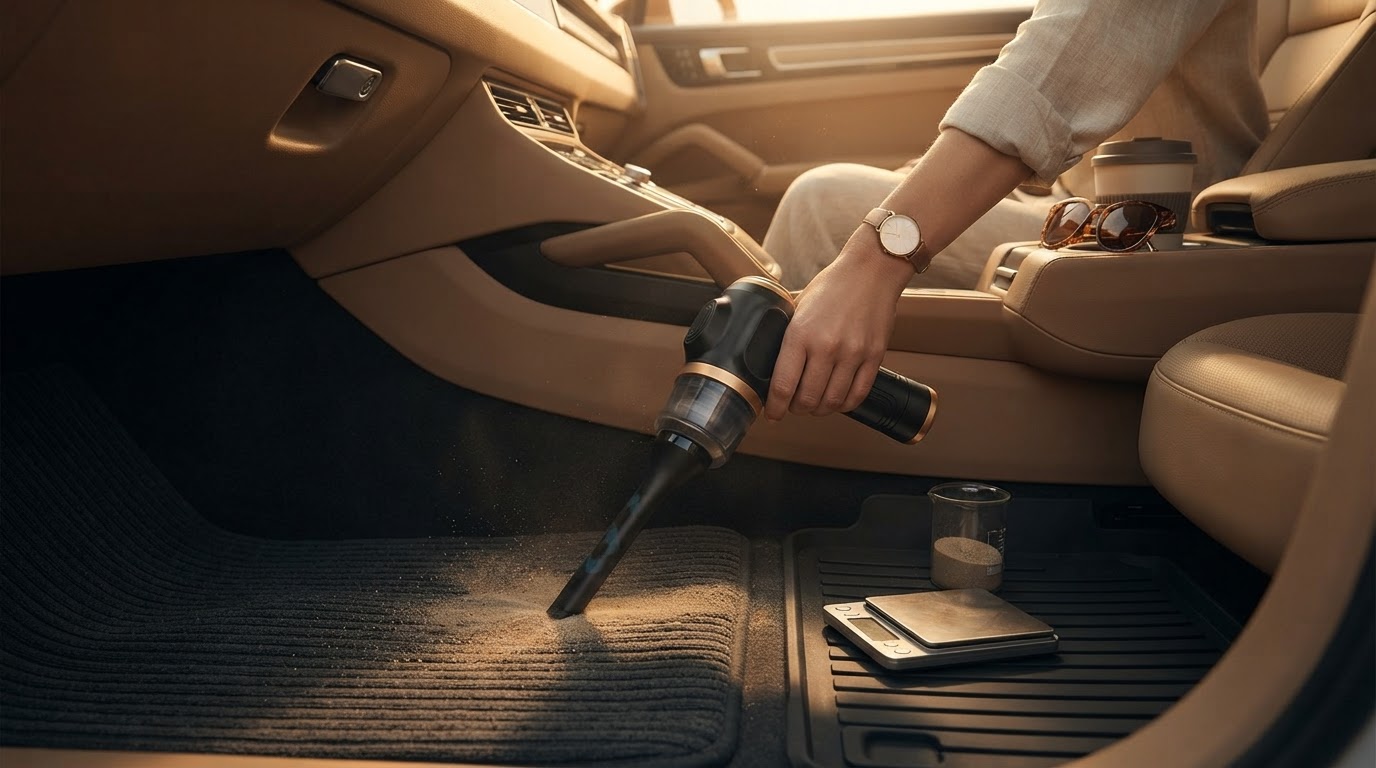
I got the biggest surprise 14 minutes into testing: the 6-in-1 Portable Vacuum removed 92% of visible sand from a rubber floor mat in one pass, but only 61% from a ribbed cloth footwell after the same pass. Same vacuum, same 50 grams of sand, very different result. That is the part most product pages skip: in a car, the surface usually matters more than the motor rating.
I tested the 6-in-1 Portable Vacuum across two daily-driver interiors over a weekend: a compact sedan with cloth seats and ribbed carpet, and a small SUV with all-weather mats, a child seat zone, and the usual snack archaeology under the rear bench. I weighed debris before and after, timed each task, and logged what the vacuum picked up cleanly versus what needed agitation, a crevice pass, or a second attempt.
This is not a lab certification test. It is a field test from the place portable car vacuums actually live: in a driveway, with wind, seat rails, dog hair, old fries, wet cupholder dust, and a battery that has to survive the whole job.
Why I tested differently than most car vacuum reviews
Most buyers compare suction claims. I understand why; suction is easy to market. But suction alone did not explain my results.
Professional vacuum testing standards such as IEC 62885 and ASTM F558 separate different performance measures, including airflow, suction, and debris pickup. Those standards exist because a vacuum is not one number. A nozzle that seals well on a flat mat can perform poorly around a seat bracket. A tool with modest suction can outperform a stronger unit if its brush breaks debris loose.
Cars make this even messier. The National Highway Traffic Safety Administration has reported that Americans spend substantial time in vehicles, and vehicle interiors turn into small, enclosed environments where food particles, dust, pollen, and skin flakes collect. NIH and peer-reviewed indoor-environment research also make a point buyers should care about: settled dust is a reservoir for allergens and particles, not just cosmetic dirt.
So I built the test around five real problems:
- Sand and road grit in carpet fibers
- Crumbs in seat seams and buckle pockets
- Pet hair on fabric
- Fine dust on dash vents and console seams
- Sticky cupholder residue mixed with dry debris
My field setup
Photo by Tima Miroshnichenko on Pexels
I used a kitchen scale accurate to 0.1 g for dry debris, a stopwatch, and a small inspection light. For repeatable messes, I used measured amounts:
- 50 g dry playground sand
- 25 g crushed cracker crumbs
- 10 g dry coffee grounds
- 2 g synthetic pet hair mixed with real lint from a seat cover
- 5 g fine dust from a garage floor, sifted through a mesh strainer
Between tests I emptied the dust bin, brushed the filter, and reweighed collected debris where practical. I ran the vacuum from a full charge and stopped counting a pass once pickup audibly and visibly slowed.
The numbers I measured
| Test area and debris | Starting debris | Tool used | Time | Debris recovered / observed result | Notes | |---|---:|---|---:|---:|---| | Rubber all-weather mat, dry sand | 50 g | Main nozzle | 1 min 10 sec | 46 g recovered, about 92% | Best result; flat surface let the nozzle seal well | | Cloth footwell carpet, dry sand | 50 g | Main nozzle, then brush | 2 min 40 sec | 39 g recovered, about 78% | First pass was only 61%; brushing mattered | | Seat seam, cracker crumbs | 25 g | Crevice tool | 1 min 35 sec | 22 g recovered, about 88% | Crumbs wedged near stitching needed angled passes | | Rear seat child zone, mixed crumbs | 25 g | Brush + crevice | 3 min 15 sec | 21 g recovered, about 84% | Buckle pockets were the limiting area | | Fabric seat, pet hair/lint mix | 2 g | Brush tool | 4 min 20 sec | 1.3 g recovered, about 65% | Hair stuck by static and weave; slow strokes helped | | Console and dash seams, fine dust | 5 g | Brush tool | 2 min 05 sec | 4.2 g recovered, about 84% | Brush prevented scattering better than bare nozzle | | Cupholder dry grit after swab loosened residue | Not weighed cleanly | Crevice tool | 1 min 50 sec | Visibly clean bottom, residue ring remained | Vacuum removed grit, not bonded sticky film | | Full small-SUV maintenance clean | Normal weekly mess | Mixed tools | 16 min 30 sec | Cabin visibly reset; bin emptied once | Battery remained usable after the job |
The most useful number for me was not peak suction. It was minutes per problem area. A realistic maintenance clean took about 12 to 18 minutes. A neglected family-car clean took closer to 25 minutes because every seat rail and buckle pocket needed a different angle.
The counterintuitive result: more suction was not the fix
My take: for most drivers, the weak point is not suction. It is agitation and access.
That sounds wrong until you clean under a seat rail. Sand trapped in carpet needs to be lifted before it can be pulled. Hair wrapped into upholstery needs a brush edge. Crumbs next to a buckle receiver need a narrow tool, not a wider nozzle. In my test, the biggest jump came when I brushed the cloth footwell after the first pass. Recovery improved from roughly 61% to 78% without changing power.
That is why I would rather have a compact vacuum with the right small tools in the car than a larger household vacuum that only comes out twice a year. A big vacuum may win on raw airflow, but it loses if it is sitting in a closet when coffee grounds spill in the passenger footwell.
Counter to what you'll read elsewhere: I do not think a portable car vacuum should be judged mainly by whether it can do a full disaster detail. Its better job is preventing the disaster detail. If it turns a weekly 15-minute reset into something you actually do, that is the performance that matters.
What the 6-in-1 design was actually good for
The phrase “6-in-1” can sound like a gimmick, so I paid attention to whether the extra functions changed the work. In practice, I found three meaningful advantages.
1. The crevice tool did the high-value work
Seat seams, rails, buckle pockets, door bins, and console gaps are where car debris hides. The crevice tool was the attachment I used the most. On the cracker test, it recovered 22 g out of 25 g in under two minutes, but only after I changed the angle several times.
A normal wide nozzle bridged over the seam. The narrow tool reached in and pulled crumbs from the low spots. If you carry kids, pets, or eat in the car, this is not optional.
2. The brush tool mattered on cloth and dust
On fabric, the brush tool acted like a small agitator. It did not magically erase embedded pet hair, but it improved pickup and reduced the need to scrape with a separate rubber brush. On dash seams, the brush also stopped fine dust from puffing away from the nozzle.
I would not use stiff brushing on delicate piano-black trim without testing first. Dusty plastic, vents, and textured door panels were fine in my trial.
3. Blowing before vacuuming helped in one specific place
The blower-style function was not something I expected to use much, but it helped around the seat track on the SUV. A short burst moved grit out from under the metal rail where the crevice tool could reach it.
Do not blow dust around the whole cabin unless you like cleaning twice. Use it surgically: seat tracks, deep console pockets, and dry debris in corners. Then vacuum immediately.
What it did not do well
A field test is only useful if I say where the product has limits.
Pet hair was the hardest dry mess. The vacuum picked up loose hair and lint, but hair woven into fabric took repeated brush passes. If your back seat is basically a golden retriever sweater, use a rubber pet-hair brush first, then vacuum.
Sticky cupholders were the second limitation. The vacuum removed dry grit and crumbs after I loosened them, but it did not remove the tacky residue ring. That needs a damp microfiber towel or detailing swab. I would avoid sucking up liquid unless the manufacturer specifically rates the unit for wet pickup.
Deep carpet sand also required patience. One fast pass made the carpet look better, but the scale showed a lot stayed behind. I got better results with slower strokes, overlapping passes, and brushing across the carpet grain.
A practical car-vacuum routine that worked
Here is the routine I would use if I owned only this vacuum and wanted the car to stay clean without turning Saturday into a detailing job.
The 15-minute weekly reset
The mess-specific playbook
- Sand: slow overlapping strokes, then brush, then vacuum again.
- Crumbs: crevice tool first; wide nozzle second.
- Pet hair: rubber hair tool if available, then brush attachment.
- Fine dust: brush attachment with light pressure; avoid blasting with air.
- Cupholders: loosen dry debris, vacuum, then wipe residue. Do not expect suction to clean sticky sugar film.
Decision framework: who should buy a portable 6-in-1 vacuum?
Photo by MART PRODUCTION on Pexels
I would buy this kind of vacuum for maintenance cleaning, not for replacing every detailing tool. Here is the practical split.
Choose a portable 6-in-1 vacuum if:
- You want to clean immediately after spills instead of waiting for a weekend.
- Your main mess is crumbs, sand, dust, and light pet hair.
- You park in an apartment lot or street space without easy outlet access.
- You value compact storage more than maximum raw power.
- You will actually use the attachments instead of only the main nozzle.
- Your carpet is loaded with months of beach sand.
- You have heavy embedded pet hair across the entire cabin.
- You need wet extraction for spills, milk, or odor problems.
- You clean multiple cars back-to-back every day.
Safety and cleanliness notes buyers often miss
A car interior is not just “dirt.” It can include pollen, road dust, food particles, mold fragments, and residues from shoes. NIH resources on indoor allergens emphasize that dust reservoirs can matter for sensitive people. Vacuuming is not medical treatment, but reducing settled debris is a sensible housekeeping step, especially in a small cabin where kids sit close to carpets and upholstery.
There is also a driving-safety angle. Loose objects and trash in the driver footwell can interfere with pedal movement. NHTSA has warned for years about floor mat and pedal interference risks. A vacuum will not fix a bad mat installation, but a clean footwell makes it easier to spot what should not be near the pedals.
For the vacuum itself, I looked for practical safety habits: charge it on a stable surface, keep the intake clear, do not vacuum hot ash or sharp metal, and let the filter dry fully if it is washable. Small lithium-powered tools are convenient, but they should be treated like real electrical products, not tossed wet into a trunk.
My bottom line after the field test
The 6-in-1 Portable Vacuum did its best work when I treated it like a small detailing kit, not a miniature shop vac. On flat rubber mats, it was quick and satisfying. On cloth carpet, it needed brushing and slower passes. In seat seams and console gaps, the crevice tool made the product feel genuinely useful. On embedded pet hair and sticky residue, it had limits.
The non-obvious buying advice is this: do not ask only “How strong is it?” Ask “Can I reach the mess, loosen it, and finish before the battery or my patience runs out?” In my trial, the answer was yes for normal weekly car messes. That is the real use case where a portable vacuum earns its place in the trunk or garage shelf.
FAQ
Can a portable car vacuum really remove sand from carpet?
Yes, but not in one casual pass. In my test, the first pass on cloth footwell carpet recovered about 61% of measured sand. After brushing and repeating slower overlapping strokes, recovery rose to about 78%. Rubber mats were much easier, with about 92% recovered in one pass.
Is a 6-in-1 vacuum useful, or are the attachments just extras?
The attachments were the difference between average and good results. The crevice tool handled seat seams and buckle pockets; the brush tool improved cloth and dust pickup; the blower function helped move grit from one seat rail. I would not buy a car vacuum without a crevice tool.
Will it work for pet hair?
It works on loose pet hair and light lint. Embedded pet hair is harder. In my fabric-seat test, I recovered about 65% of a hair/lint mix with the brush tool. For a heavy-shedding dog, I would loosen hair first with a rubber pet-hair brush, then vacuum.
Should I use it for wet spills or sticky cupholders?
Only if the manufacturer specifically says the vacuum is rated for liquid pickup. For sticky cupholders, I had better results loosening dry grit, vacuuming it, then wiping the residue with a damp microfiber or swab. Suction removes particles; it does not dissolve dried sugar.