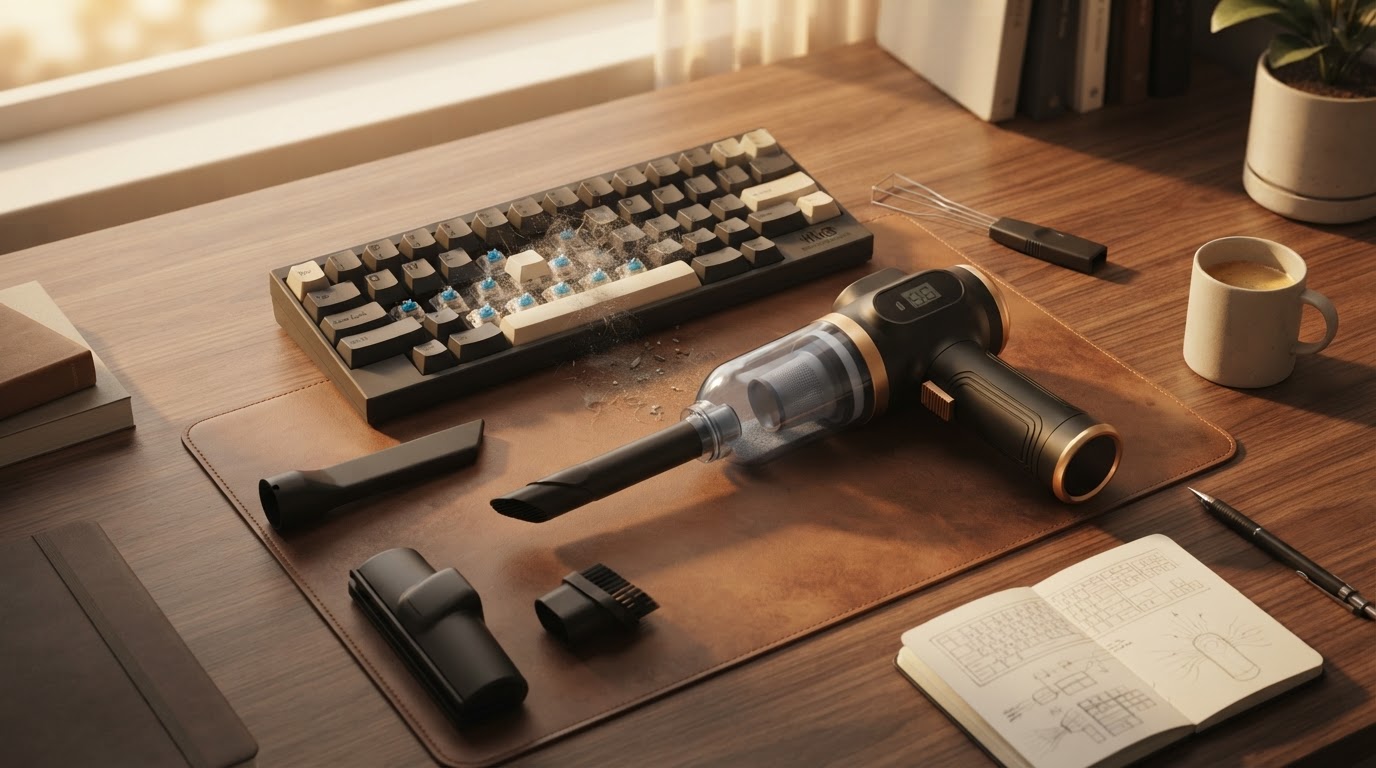
Optimizing a 6-in-1 Portable Vacuum for Keyboard Maintenance
 Maya ChenContributing Editor
November 6, 2026. This technical overview examines the efficacy of high-suction handheld devices in maintaining computer peripherals. It is written for professionals and enthusiasts seeking a data-driven approach to hardware maintenance.
The Mechanical Reality of Keyboard Contamination
The conventional wisdom says that a quick blast of air or a cursory swipe with a microfiber cloth is sufficient to maintain a workstation. However, internal debris accumulation in mechanical switches and membrane housings is a leading cause of key chatter and input failure. According to Little Obsessed, small cleaning gadgets are necessary to pick up the crumbs, glitter, and minor accidents that settle beneath the keycap level. The problem with standard desktop maintenance is that most users wait until a malfunction occurs before intervening. By that point, particulates have often migrated into the switch housing or onto the PCB, where they can cause oxidation or physical obstruction. When evaluating a portable mini vacuum for keyboard use, the primary metric is not just raw suction power, but the ability to concentrate that vacuum force into narrow apertures between keys. Many users mistakenly believe that any handheld device will suffice, yet low-power USB-tethered alternatives often lack the static pressure required to dislodge skin cells and oils that act as adhesives for dust. This is where a rechargeable air duster for electronics differs from basic consumer toys; it must bridge the gap between a superficial sweep and a deep mechanical cleaning. If the device cannot generate enough lift to overcome the surface tension of settled debris, it is effectively useless. Furthermore, the reliance on disposable canisters creates a thermal drop that can introduce moisture into sensitive electronics—a risk factor that is frequently ignored in home office setups. Transitioning to a compressed air duster alternative is often a move driven by long-term cost-benefit analysis rather than just immediate convenience.
Technical Implementation of the 6-in-1 Portable Vacuum
Here's the part nobody talks about: suction alone is often insufficient for a truly clean keyboard. The 6-in-1 Portable Vacuum addresses this by utilizing a dual-mode system that functions as both a high-velocity blower and a high-suction vacuum. While many products on AliExpress claim portability, they rarely provide the 6-in-1 versatility required for diverse electronics. Run the math: a standard membrane keyboard has 104 keys, each with roughly 2mm of clearance. To effectively clear these gaps, the 6-in-1 Portable Vacuum utilizes specialized nozzle attachments that increase air velocity by narrowing the output path. This allows it to function as a keyboard cleaner air blower, dislodging stubborn particles before switching to vacuum mode to remove them from the environment entirely. Without the vacuum phase, blowing simply redistributes the dust into the room or back into the computer's intake fans. The device’s cordless design is not merely a convenience; it allows for the 360-degree maneuverability required to clean vertical surfaces like monitor vents and back-mounted I/O ports. Unlike the rechargeable keyboard cleaner air blower models that prioritize one function over the other, this 6-in-1 unit maintains a balance of high-RPM motor speed and filtration efficiency. The HEPA-style filter is critical here; without it, a portable vacuum simply acts as a dust spreader, exhausting fine particulates back into the user's breathing zone. The integration of a rechargeable battery eliminates the voltage drop-off seen in older USB-powered models, ensuring that the suction remains consistent throughout the cleaning session. This is particularly relevant for those using the device as a rechargeable air duster for electronics, where sustained pressure is needed to clear heat sinks and cooling fins without the risk of liquid propellant discharge.
Decision Framework for Electronics Maintenance Tools
When selecting a portable mini vacuum for keyboard and desk maintenance, the hardware specifications must align with the sensitivity of the equipment being cleaned. A high-suction car vacuum might be too powerful, potentially dislodging keycaps or damaging delicate ribbon cables if used improperly, whereas a weak desk vacuum will fail to pull debris from deep within the chassis. A balanced tool must offer variable attachments and a motor capable of sustained high-velocity output. I’ll change my mind when a single-function tool can demonstrate higher efficiency than a multi-functional system, but currently, the 6-in-1 Portable Vacuum offers the most logical workflow for hardware longevity.
- Static Pressure vs. CFM: Prioritize tools that can concentrate airflow into narrow nozzles rather than those that move large volumes of air at low pressure.
- Dual-Functionality: Ensure the device can both blow and suck; dislodging dust is only half the battle.
- Filtration Quality: Look for washable, high-density filters to prevent the recirculation of fine allergens and dust.
- Attachment Variety: A minimum of three nozzle types (brush, crevice, and blower) is required to navigate the varied geometry of modern peripherals.
- Battery Chemistry: Lithium-ion cells are mandatory for maintaining consistent power levels; avoid NiMH batteries which suffer from significant memory effect and rapid discharge.
- Maintenance Requirements: The dust bin and filter must be easily accessible for cleaning to prevent motor strain over time.